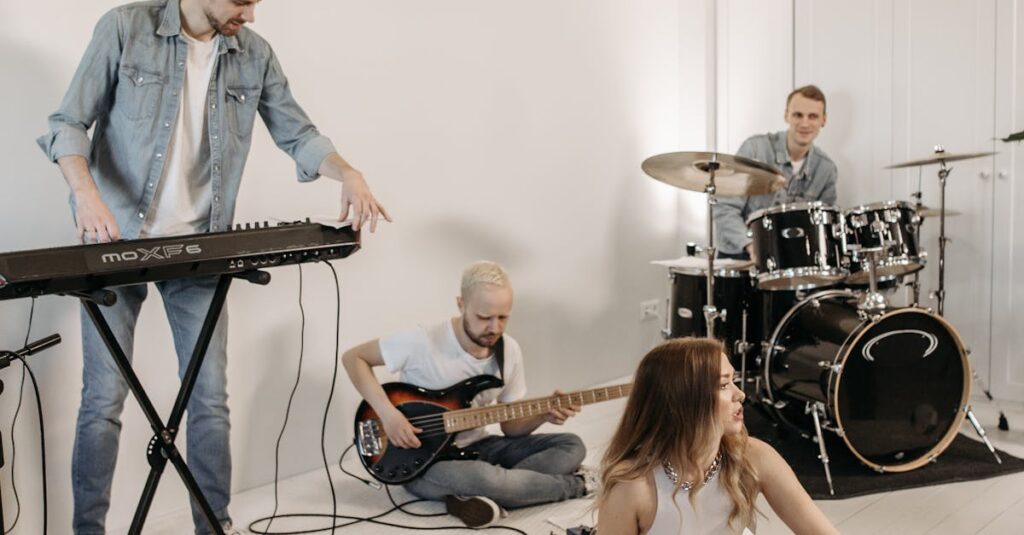
Published research reveals how a regional Australian program uses music to support young people facing adversity
Improving young people’s wellbeing has become a global priority, with rising rates of mental illness, socio-economic disadvantage, and youth struggling to thrive. While traditional support services play important roles, new research published in Research Studies in Music Education reveals how community music education can serve as a powerful transformative resource for young people experiencing challenging life circumstances.
Beyond Teaching Notes and Rhythms
In a qualitative case study conducted at a community music education program in regional Australia, researchers observed something remarkable. Young people facing mental illness, trauma, homelessness, and social exclusion weren’t just learning music—they were healing, growing, and discovering hope.
The program operates from a converted shopfront, offering free afternoon sessions that combine music-making with life skills education. Entry is open to all, regardless of previous musical experience. What makes it powerful isn’t the G chords being taught, but rather what music opens the door to: belonging, learning, and empowerment.
Three Pillars of Transformation
Using Self-Determination Theory as their lens, the researchers identified three essential pillars that satisfied young people’s psychological needs and promoted wellbeing.
Belonging emerged as the leading psychological need. Participants described experiencing a family-like environment characterised by unconditional support, no judgment, and genuine connection. As one young person, Ryan, shared: “I found a group of people that I can talk to, and I can trust in… The fact that I was able to come to this place and express any pains or thoughts… was amazing.”
Learning occurred through what facilitators cleverly termed “sneaky learning.” Young people came for the music—songwriting, recording, performing—but stayed for life skills education covering budgeting, employment, housing, and healthy relationships. Music served as the hook; life transformation was the outcome.
Empowerment developed as young people took control of their lives, experienced accomplishment, and discovered purpose. Facilitators functioned as relatable role models, many having overcome similar adversities themselves. As facilitator Jackson explained: “We’re using music for life and for growth and happiness and safety and joy.”
Disrupting Traditional Music Education
This research challenges conventional approaches to school music education. Rather than prioritising technical mastery or career preparation, this program demonstrates how music education can achieve musical flourishing for all by removing entry barriers, combining informal music with formal life learning, and emphasising personalised goals that prioritise wellbeing.
The findings reveal that satisfying psychological needs—particularly relatedness, competency, and autonomy—is fundamental to supporting young people’s wellbeing through music. Facilitators provided intensive individual support, meeting young people where they were and empowering them to envision healthier futures.
Music for Life, Not Just for Music’s Sake
This innovative model proves that community music education can be more than entertainment or artistic development—it can be a lifeline. By using music as a medium for transformation rather than an end goal, programs can reach vulnerable young people and provide the support, skills, and hope they need to thrive.
The study, conducted by Dr Jason Goopy and Dr Stephanie MacArthur from Edith Cowan University, advances understanding of Self-Determination Theory in music learning contexts with vulnerable youth.
Read the full research article: Goopy, J., & MacArthur, S. (2026). Psychological needs and wellbeing in community music education for young people experiencing challenging life circumstances. Research Studies in Music Education. https://doi.org/10.1177/1321103X251410565