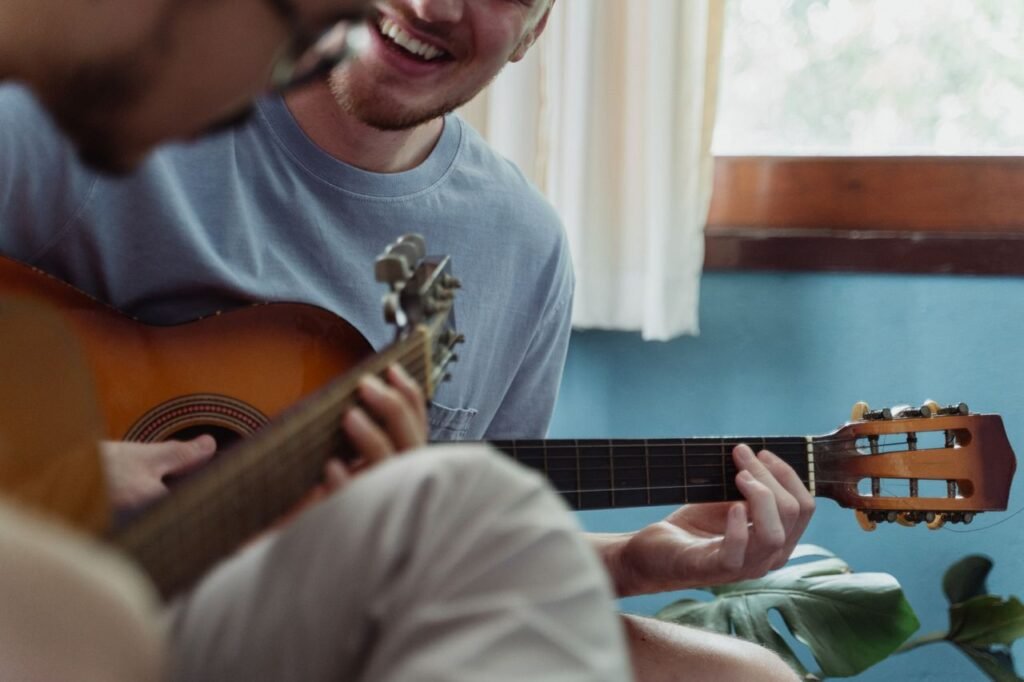
For young people, music can be far more than entertainment — it’s how they process a hard day, say what they can’t put into words, and steady themselves when life feels overwhelming. Jason Goopy’s new study in the International Journal of Applied Positive Psychology gives this everyday reality a name: music as a language of wellbeing, one that schools can teach as deliberately as any other.
A New Idea: Music-Wellbeing Literacy
The study introduces music-wellbeing literacy: the combined literacies of music and wellbeing. Drawing on positive psychology’s concept of “wellbeing literacy” — our capability to comprehend and compose the languages of living well for self and others — it sets out five interconnected capabilities, each written from the young person’s point of view:
- Knowledge and skills — “I have music knowledge and skills that I can use, and that other people understand, to help myself and/or others, feel good, and function well.”
- Understanding and responding — “I can understand and respond to music to feel good, function well, and contribute to others’ wellbeing.”
- Making music — “I can make music about things that make me happy and that promote happiness in others.”
- Adapting to context — “I know that responding to and making music can be different in different places, with different people and different circumstances.”
- Using music intentionally — “I can purposefully use music (by making and responding) for, as, and about my own wellbeing and that of others.”
What the Students Showed
The study followed three 16-year-olds — Aurora, Ellie, and Rowan — at a small Australian music-focused school that re-engages students who had left mainstream education. Through drawings and their own original songs, each showed music working as a genuine wellbeing language: Aurora “communicates through music,” Ellie treats it as constant company (“music is always there for me”), and Rowan uses it to grow and imagine a future. Across their stories, five wellbeing experiences emerged — flow, emotion management, connection, identity work, and learning — with songwriting drawing on all five. The key point is that these teens weren’t passive listeners; their listening and music-making were themselves acts of wellbeing.
Putting It to Work in Schools
The study’s real payoff is practical. Music education, it contends, too often teaches technique without connecting it to living well, leaving wellbeing to a “hidden curriculum.” Instead, these capabilities can be built intentionally and visibly into activities schools already run — deepening musical rigour rather than diluting it. The article offers concrete starting points teachers can adapt:
- Build the vocabulary. Have students create a shared language for how tempo, dynamics, and timbre affect emotion, then use those terms to curate mood-specific playlists.
- Teach regulation through making. Use songwriting structure (verse–chorus–bridge) to express and manage feelings, and practise active listening to identify what actually calms or energises us.
- Assemble a “wellbeing toolkit.” Students design personalised kits — playlists, simple instruments, and lyrics — to use intentionally across different emotional states.
- Make it social. Set up a “wellbeing music request” system where students commission peers to create or curate music for specific purposes (calming before a presentation, energising for sport), or a peer-support initiative where trained student musicians run short improvisation sessions to help classmates process difficult transitions.
- Explore context. Perform the same piece in different spaces, or interview family members about how music use shifts across life’s circumstances, to see how setting and situation change music’s effect.
The Takeaway
For these adolescents, music is a real language of wellbeing — and one schools can help every student learn to speak. Treated intentionally, music education can grow not just skilled musicians, but young people fluent in a language that helps them, and others, flourish.
This study is freely available open access and can be read in full here: https://doi.org/10.1007/s41042-026-00289-7
Goopy, J. (2026). Multimodal narratives of adolescents’ music-wellbeing literacy capabilities in a music-focused secondary school. International Journal of Applied Positive Psychology, 11, 31. https://doi.org/10.1007/s41042-026-00289-7